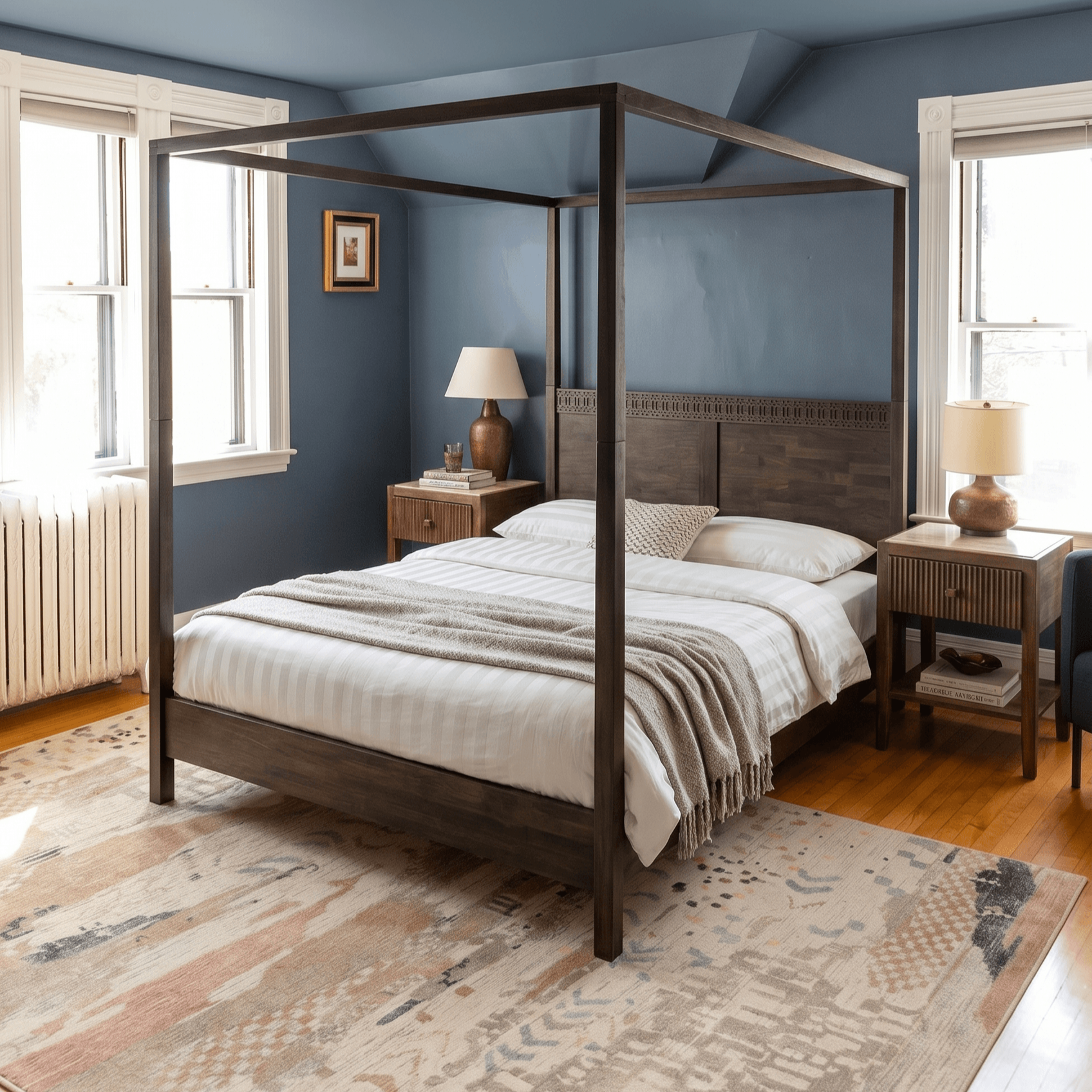
This is the room where the right order is the least obvious. The instinct is to start with the bed frame: to choose a bed by how it looks, and build outward from there. But the frame, for all its visibility, is one of the least important decisions in the room, and one of the most constrained — by the mattress it has to hold, the scale of the room, the clearance the bedside tables need. The piece that matters most is the one no one will ever see.
1. The mattress
The mattress is bought first, and it is the one piece in the room that no one will ever see. This is the inversion the bedroom asks for. Every other room is furnished for the eye. The bedroom is furnished, first, for the body. It is also the only object in the room that affects sleep, which is the main thing the room is actually for. A beautiful bedroom built on a bad mattress is a beautiful room a person dreads lying down in. Spend here before anywhere else, and spend without reference to how it looks, because it will be covered within the week and never seen again.
Two decisions follow from the mattress that constrain everything after it: its depth, which sets the height of the made bed, and its dimensions, which set the scale of the frame. Choose it first and the rest of the room has something to measure against.
2. The bed frame
Now the frame, with the mattress chosen and its height and footprint known. The temptation, again, is to choose by style. The better question is proportion. A high frame in a low-ceilinged room closes the space; a low frame opens it. As a rule, the lower the ceiling, the lower the frame should sit. The bed is the largest object in the room and it sets the room's horizon — a low bed reads as calm, a tall one as a statement. Most bedrooms are better for a frame lower than instinct suggests.
If going for a headboard, this would be the room's largest soft surface, and the decision that does the most work. Choose its material before its style: an upholstered headboard in undyed linen or wool warms a room more than any cushion arrangement can, and outlasts every trend in shape.
3. The bedside tables
Before lighting, the bedside tables — because they decide where light can go. There is no point choosing a lamp before the surface it has to stand on. The functional rule: the surface should sit at, or just above, the height of the made mattress. Too low and reaching for a glass of water in the dark becomes a hunt; too high and the table looms over the bed. A surface level with the mattress is the one that disappears into use, which is what a bedside table is for.
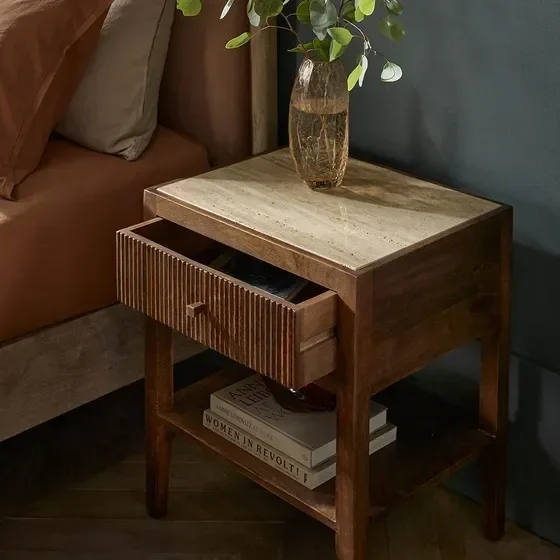
Atkin and Thyme — Mirabelle Travertine Bedside Table, £299
4. The lighting
Most bedrooms have one light source, overhead, controlled by the switch at the door. This is the single thing that keeps a bedroom from feeling like a bedroom. Overhead light flattens a room and floods it; it is the light of getting dressed, not the light of winding down. The light a bedroom actually needs is bedside, at the level of a seated head — a lamp on each table, or a pair of wall lights if the surfaces are small. This is the light read by, the light left on while one person sleeps and the other does not, the light that makes the room feel occupied rather than vacated.
One rule matters more than any other here, and it is about the bulb, not the lamp. Nothing above 2700K reads as warm in a bedroom. Most lamps are sold with bulbs too cool and too bright for the room; a warm bulb at a low lumen count, ideally on a dimmer, will do more for the feel of a bedroom than any amount spent on the fitting. The overhead light, if it must stay, is for mornings. The evenings belong to the lamps.
5. The rug
Not always space for it, but the placement is specific to the room and most people get it wrong. The rug does not belong centred under the bed, where most of it vanishes underneath and only a border shows. It belongs running out from beneath the lower two-thirds of the bed, extending past the sides and the foot, so that wherever a foot lands stepping out of bed, it lands on something soft. Bought to that placement, a rug needs to be larger than instinct suggests — the most common bedroom rug is bought a size too small.
6. The soft layers
Now the bedding, and the textiles that turn a made bed into a place worth getting into. This is where the room is most often over-furnished — too many cushions, too many patterns, a throw competing with a quilt competing with a print on the wall.
The restraint that works: one set of undyed or muted linen does more than any patterned set, and it ages into the room rather than out of fashion. Pattern and colour, if wanted, belong in one element — a single throw, a pair of cushions — not five. The eye reads a quiet bed as calm and a busy one as a showroom. A bedroom is the one room that should never read as a showroom.
7. The bed wall
Elsewhere in a home, a single large piece above the bed usually beats a scattered arrangement — one thing, well chosen, anchoring the wall. The bedroom is the exception. The wall above a bed is the wall above resting heads, and a single heavy framed piece hung there is a thing most people are right to feel uneasy about. Lighter works/textiles, or a shelf, are slightly more practical over a bed than a large piece on a hook.
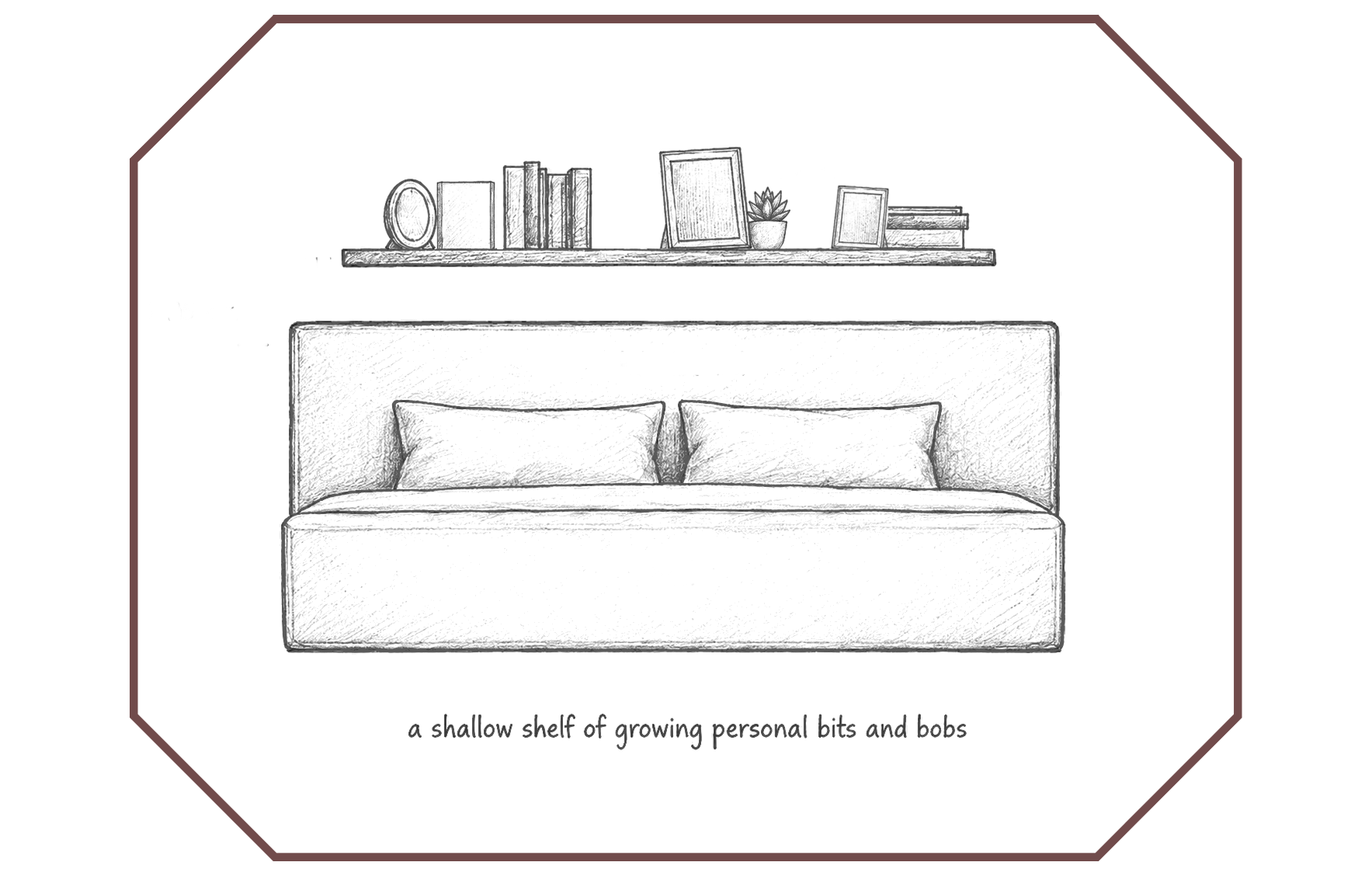
The better reason is what the wall is for. This is the most personal wall in the house — the last thing seen before sleep, the first on waking — and a single image has to carry all of that meaning alone, which is a hard thing to ask of one object. A shelf, or a loose picture cluster, does it more easily: a couple of different sized prints leaning on a shallow shelf rather than hung, an object that means something, something inherited or found. Each piece carries a little of the weight, and the arrangement can grow as things accrue, rather than being decided once.
There is a third route, which is to let the wall itself do the work. The wall behind a bed is the one wall in a home that can carry pattern without it overwhelming the room — a patterned wallpaper wall fills the space on its own, and asks for little or nothing hung on top of it. Panelling or a textured paint job can break up the wall visually. The one rule that holds across all: keep it low. Whatever sits above the bed — shelf, cluster, single piece, or nothing at all over paper — should sit close to the headboard, not floating in the empty wall above it.
A note on sequence over speed
The bedroom rewards slowness more than any room, because it is the one experienced half-asleep, twice a day, every day. A room furnished for a photograph and a room furnished for waking up in are different rooms, and the difference is rarely visible in a photograph at all. It is felt at six in the morning and eleven at night, in the dark. Buy slowly, buy in this order; the mattress first, the wall last, and the room will settle into something that feels ownable and personal.