Choosing a rug: a guide
A rug does more for a room than almost any other piece of furniture in it. It anchors the seating zone. It defines where the room begins and the circulation ends. It warms the floor, absorbs sound, and — if chosen well — ages into the room rather than out of it. The rooms that look effortless are almost always the ones where the rug was the first decision. Not the last accessory chosen to fill a gap, but the foundation everything else was built on. What follows is how to choose that foundation. Less about taste than about getting the basics right.
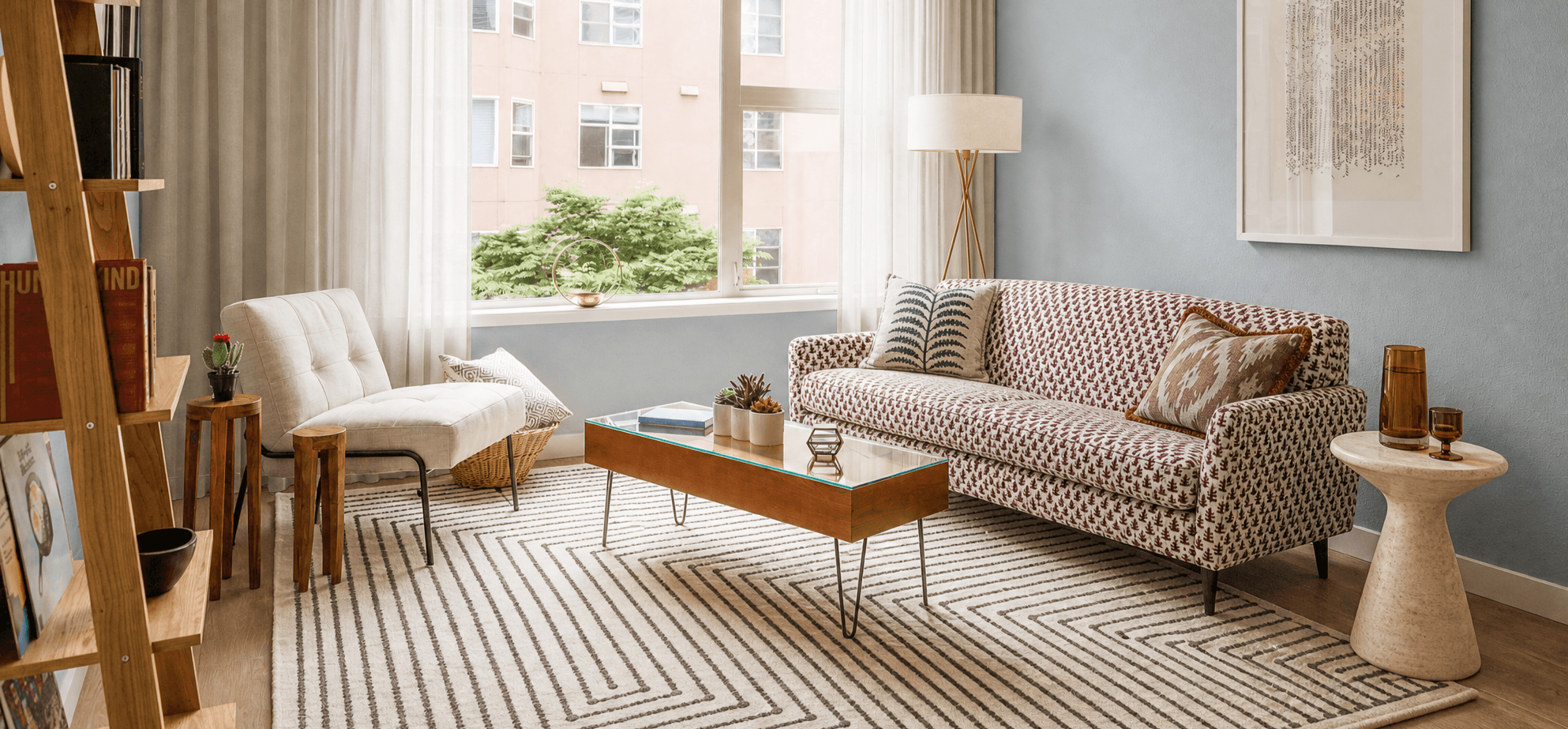
The rug as the foundation, not the accessory
The first thing to understand is what a rug does. It is not decoration. It is the surface on which the room sits. A rug draws a line. It marks where the room within the room begins — the seating zone, where the sofa and chairs belong — and where the circulation space ends. The bare floor around the rug is for walking through; the carpeted area is for stopping. Without a rug, this distinction collapses, and furniture floats untethered in the middle of a wider space. This is why so many otherwise well-furnished living rooms feel slightly unfinished. There is no zone. The eye can find no edge to the seating area. The room becomes a collection of objects rather than a place. Choose the rug early, and choose it deliberately. Everything else in the room sits on or relates to this anchor.
Size: the rule that does the most work
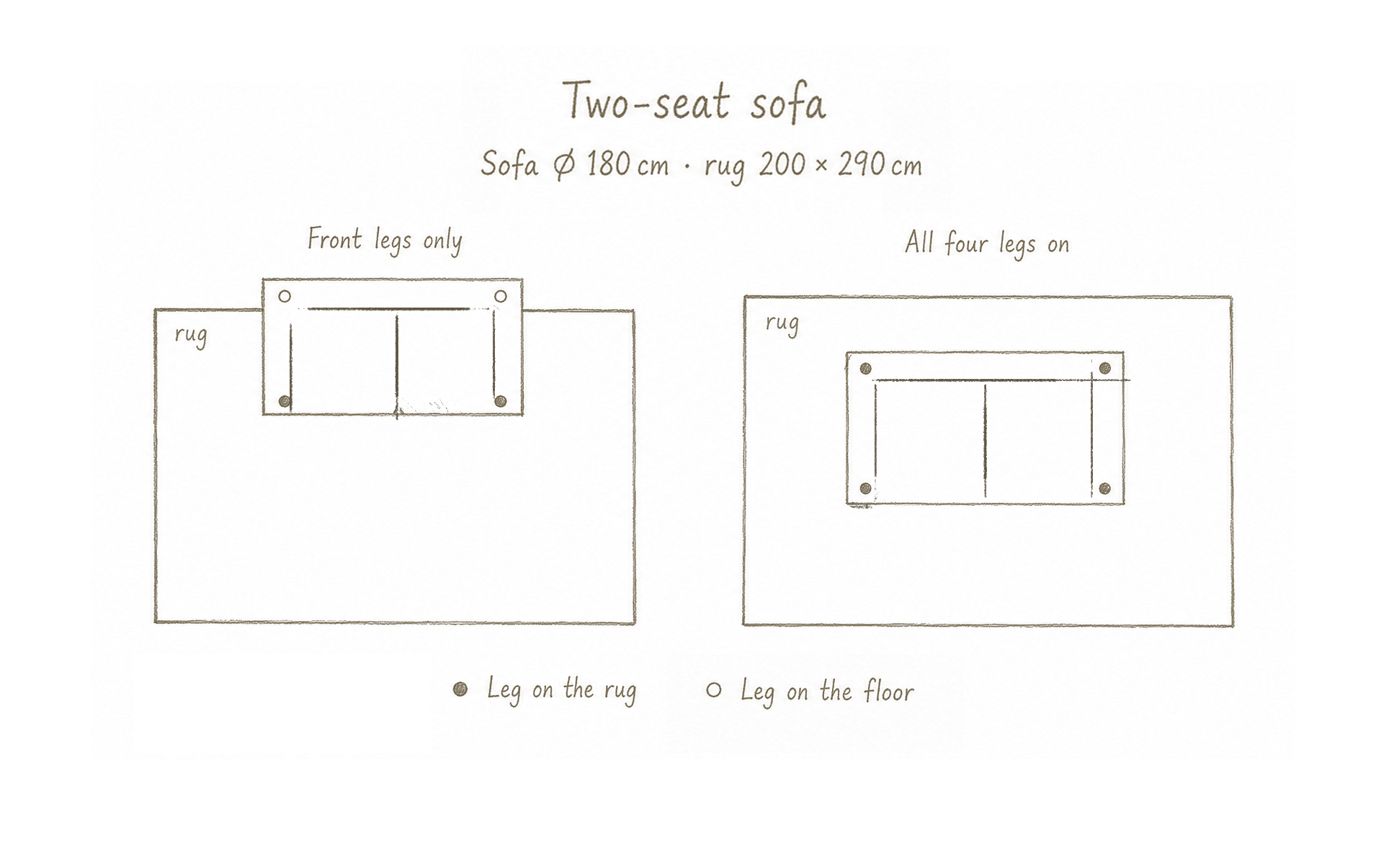
Most rugs are bought too small. The error is so common it has become the default; people see undersized rugs in showrooms, in photography, in friends' houses, and assume the proportions are correct. They are not. The rule, simplified: every primary piece of seating in the room should have at least its front legs on the rug. The sofa's front legs. The armchair's front legs. The accent chair if there is one. Anything that is part of the seating zone needs to touch the rug.
For most living rooms, this means a rug significantly larger than instinct suggests. As a baseline:
— A standard three-seat sofa (around 220cm wide) wants a rug at minimum 200 × 290cm, ideally 240 × 330cm.
— A two-seat sofa or loveseat (around 180cm) can work with 170 × 240cm, but 200 × 290cm reads more considered.
— An L-shaped or corner sofa needs a rug large enough that the front of both sides touches the rug. This usually means 240 × 330cm or larger.
— A dining table wants a rug that extends at least 60cm beyond the edge of the table on all sides — far enough that chairs remain on the rug when pulled out to sit down.
Smaller rugs (160 × 230 and below) work only as accent pieces — in a hallway, beneath a small round table, layered on top of a larger rug, or in genuinely small rooms where a 200 × 290cm rug would dominate.
The corollary: if the rug must be smaller than the rule suggests, the rug is wrong for the room. Either the rug needs to be larger or the seating arrangement needs to change. A rug that is too small cannot be styled into the right size; it will always read as an accessory dropped into the middle of a room rather than the surface the room is built on.
Shape
The rectangle echoes the architecture of most rooms and frames the seating zone clearly. Round rugs work in specific contexts — under a small round dining table, in an entryway, in a particularly small or oddly shaped room — but rarely as the primary anchor of a seating area. Square rugs are even more limited; outside of very specific square rooms with central seating, they tend to read as compromised. If in doubt, rectangular. The exceptions are rare and visible when they work.
Material: what to know
Material is where rugs vary most in price, durability, and how they age. The five main options:
Wool. The longest-wearing material, and the one that ages best. A good wool rug develops a patina over decades — slight thinning in the most-walked paths, a gentle softening of the dye — that reads as considered rather than worn out. Wool is naturally stain-resistant (the lanolin in the fibres repels liquid for crucial seconds before absorbing), resists crushing, and recovers from compression. The right choice for any room that sees daily use. New hand-knotted wool rugs run from £400 for small sizes up to several thousand for large or fine pieces.
Cotton. Lighter, less expensive, less warm-feeling underfoot than wool, with a flatter weave that suits more contemporary rooms. Cotton flatweaves (kilim-style) are particularly versatile — washable, reversible, less precious than knotted wool. Best in rooms where the rug is part of a layered look or where the floor itself does some of the visual work. £80–£400 for most domestic sizes.
Jute and sisal. Natural plant fibres with a heavy, woven texture. Warm-feeling visually, cool-feeling underfoot. Works hard in country and Mediterranean-inspired rooms. The downside is wear — jute fibres shed and the surface roughens over time. Sisal is harder-wearing than jute but coarser. Both are best in lower-traffic rooms or layered beneath a smaller, softer rug on top. £100–£350 typically.
Silk and silk-blend. The finest and most expensive option, with a soft sheen and exceptional fineness of weave. Beautiful, fragile, and rarely the right choice for a primary living-room rug. Better suited to bedrooms or formal spaces with limited foot traffic. Pure silk is rare in modern production; most "silk-look" rugs are bamboo silk or viscose, which look similar but wear poorly.
Synthetic. Polypropylene, polyester, viscose. The cheapest option and the one that reads as cheapest. Synthetic fibres lack the weight and texture of natural materials; the eye registers the difference at floor level whether it consciously knows or not. Polypropylene wears reasonably well and is easier to clean than wool, which is why it dominates the budget end of the market — but the visual register is unmistakable. Acceptable as a placeholder or in a low-stakes room (a child's playroom, a rental); avoid in any room meant to be considered.
Wear, traffic, and where to invest
Different rooms wear rugs differently, and the budget should reflect this.
Living rooms. Daily foot traffic, occasional spills, the most visible rug in the home. This is the room to invest in. A good wool rug at the right size will look better in twenty years than it does on the day it arrives. Budget accordingly — £400–£1,200 for new wool, more for fine quality, often the same band for a good antique.
Bedrooms. Lower traffic, mostly bare feet, less wear. The rug here is sensory rather than structural — it cushions the step out of bed, it warms the floor. Synthetic or budget natural fibres can work because they will not see the abuse of a living-room rug. The rule is reversed: spend less on the bedroom rug, more on the living-room rug.
Dining rooms. High wear under the table from chairs pulling in and out, occasional food spills. Wool is the right answer here too, but choose a darker colour or a pattern that disguises occasional staining. Pale solid rugs under dining tables are a slow disappointment.
Hallways and entries. Highest wear of any rug in the house. This is the room for a hard-wearing flatweave or kilim — washable, replaceable, not precious. A natural jute or cotton runner is the standard answer. Spend modestly; expect to replace every five to seven years.
The general principle: budget should follow visibility and wear. A £200 hallway runner and a £900 living-room rug is a better split than two £550 rugs of equal quality but mismatched to context.
Vintage and antique rugs
Worth a section of their own, because they sit outside the new-rug market and are often the better choice when budget allows. A vintage or antique rug — typically Persian, Turkish, Caucasian, or Central Asian, hand-knotted in wool, often a hundred years old or more — does something a new rug cannot: it brings time into the room. The pattern is irregular in ways that no machine can replicate. The colours have softened with age. The pile is unevenly worn in places that tell the story of where the rug has lived. The result is a piece of furniture that reads as inherited rather than purchased. Three things to know about buying one.
Condition matters more than perfection. A vintage rug with even, considered wear is desirable. A rug with holes, structural damage, or significant fraying is not — these problems worsen and are expensive to restore. Look for a rug that has aged, not one that is failing.
Size limits are real. Vintage rugs come in the sizes they come in. Unlike new rugs, you cannot order a 240 × 330cm in a specific colourway. The hunt is for the right rug at the right size — which often takes weeks or months, browsing dealers' catalogues, returning to the same retailers repeatedly. This is part of why vintage rugs end up feeling considered. They were found, not ordered.
Price ranges widely. A modest vintage Anatolian kilim in usable condition starts at around £200–£400. A good antique Persian in a desirable size and pattern can reach £2,000–£5,000 or beyond. The mid-range — £600–£1,500 — is where most considered domestic vintage rugs sit, and it is genuinely competitive with new wool at the same price point. The vintage rug, all else being equal, will hold its value better and age more beautifully.
Patterns, colours, and the question of taste
This piece has avoided the question of taste — which colour, which pattern, which style — because taste is the part you bring. Two principles, though, that apply regardless of preference:
Choose the rug before the sofa, not after. There are more rugs in the world than sofas, in a wider range of materials and patterns. Start where the choice is widest. A sofa can be matched to a rug; matching a rug to a sofa narrows the field significantly.
A patterned rug is forgiving; a plain rug is not. A plain pale rug shows every mark, every shadow of wear, every misplaced glass of wine. A patterned rug — particularly a vintage pattern, with its irregular palette — hides almost everything. For high-traffic rooms, pattern is the practical answer as well as the editorial one. The all-white rug photographs beautifully and lives badly.
Care, briefly
Rugs need less care than people think and more attention than they often get. Vacuum regularly but not aggressively — a beater bar set too low will accelerate wear. Rotate the rug 180° once a year to even out wear from foot traffic and sunlight. Address spills immediately with cold water and a clean cloth; do not rub. For serious cleaning, professional rug cleaning every five to seven years is worth the cost for any rug over £500. Do not steam-clean a wool rug. Do not soak. Do not use general-purpose carpet cleaners. The rug will outlast all of these things if treated gently.
What it adds up to
A rug, chosen well and sized correctly, is the single piece of furniture in a room that does the most for what is spent on it. It anchors the seating zone. It warms the floor. It absorbs sound. It ages into the room rather than out of it. The rooms that look effortless are almost always the ones where the rug was the first decision, not the last. Buy slowly. Size up rather than down. Choose material to match how the room is used. And when budget allows, choose vintage — for the patina, for the irregularity, for the way an old rug brings time into a new room.