Where to start when furnishing a living room from scratch
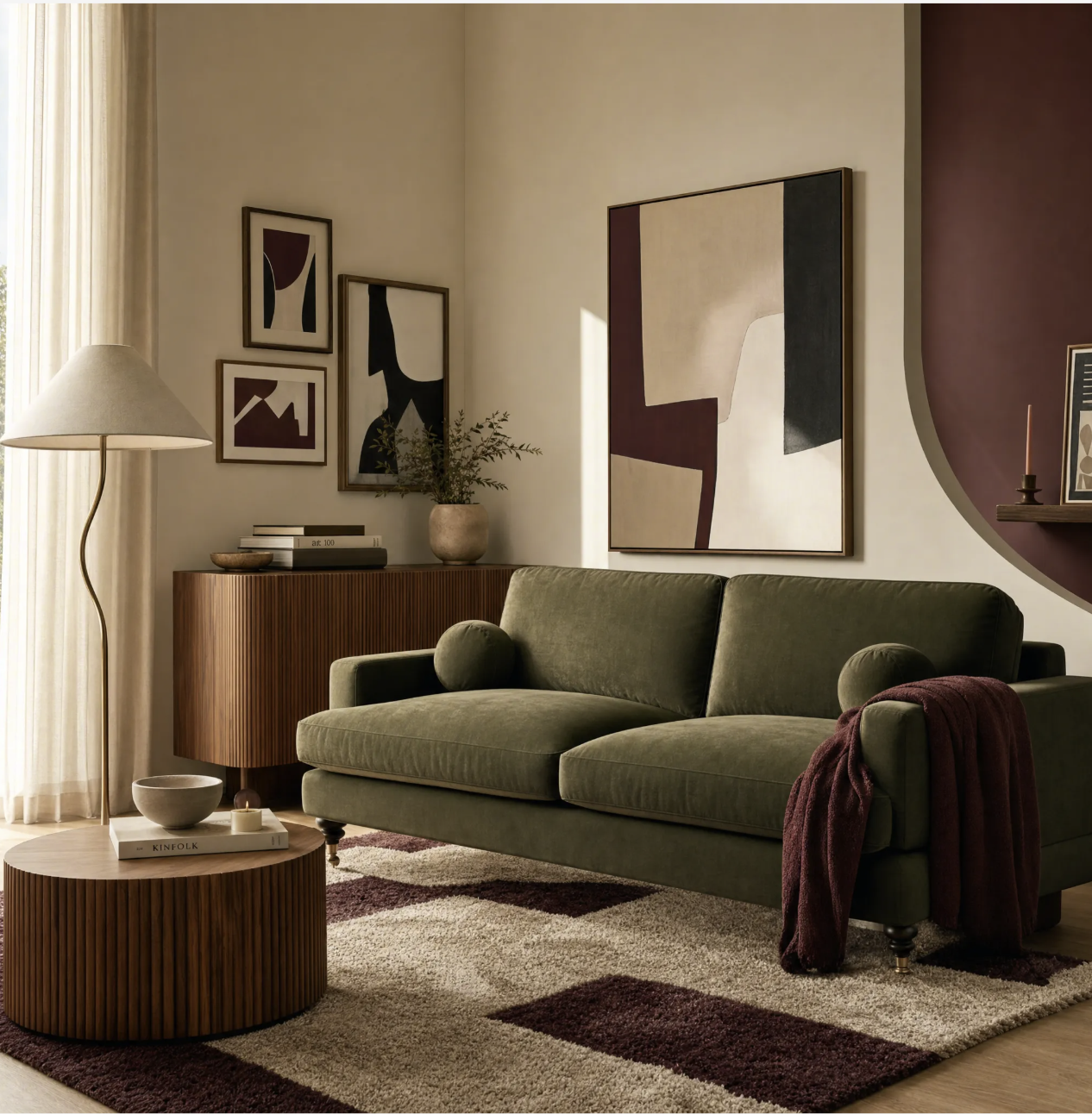
There is a particular kind of paralysis that sets in when a living room is empty. It is not lack of inspiration — most people have folders of saved images, screenshots, vague intentions. It is the question of sequence. Which piece first. Which piece can wait. Which decisions lock the others in place. The instinct is to start with the sofa. This is usually wrong. The sofa is the most expensive, the most permanent, the hardest to return, and — crucially — the piece most influenced by everything around it. The right sofa in the wrong room reads as the wrong sofa. Starting there is starting with the answer before the question.
1. The rug
Before the sofa, before anything upholstered, the rug. It establishes the zone of the room — where the seating ends, where the walking begins. It anchors scale. A room with no rug, or with a rug too small, feels unfinished even when fully furnished. It is the floor of the room within the room. Choose it before the sofa for one reason: the rug is harder to match to a sofa than a sofa is to a rug. There are more rugs in the world than sofas. Start where the choice is widest. A note on size: most rugs are bought too small. The front legs of the sofa should sit on it. If they do not, the rug is decoration, not foundation.
2. The sofa
Now the sofa. With the rug chosen, two things are resolved: scale (the sofa should not extend significantly beyond the rug's width) and palette (the sofa should sit within a tone or two of the rug's warm or cool register). The temptation is to choose a sofa by style. The better question is proportion. A deep sofa in a small room reads as a beached object. A low sofa in a high-ceilinged room reads as missing a piece. Measure the room, then the sofa, then the room again. One piece of advice that costs nothing: in a warm-modernist room, a sofa in an undyed or muted upholstery — oat, stone, putty, clay — will outlast every other choice. Pattern and colour are easier to add through cushions and throws than to remove from a £1,200 piece of furniture.
3. The lighting
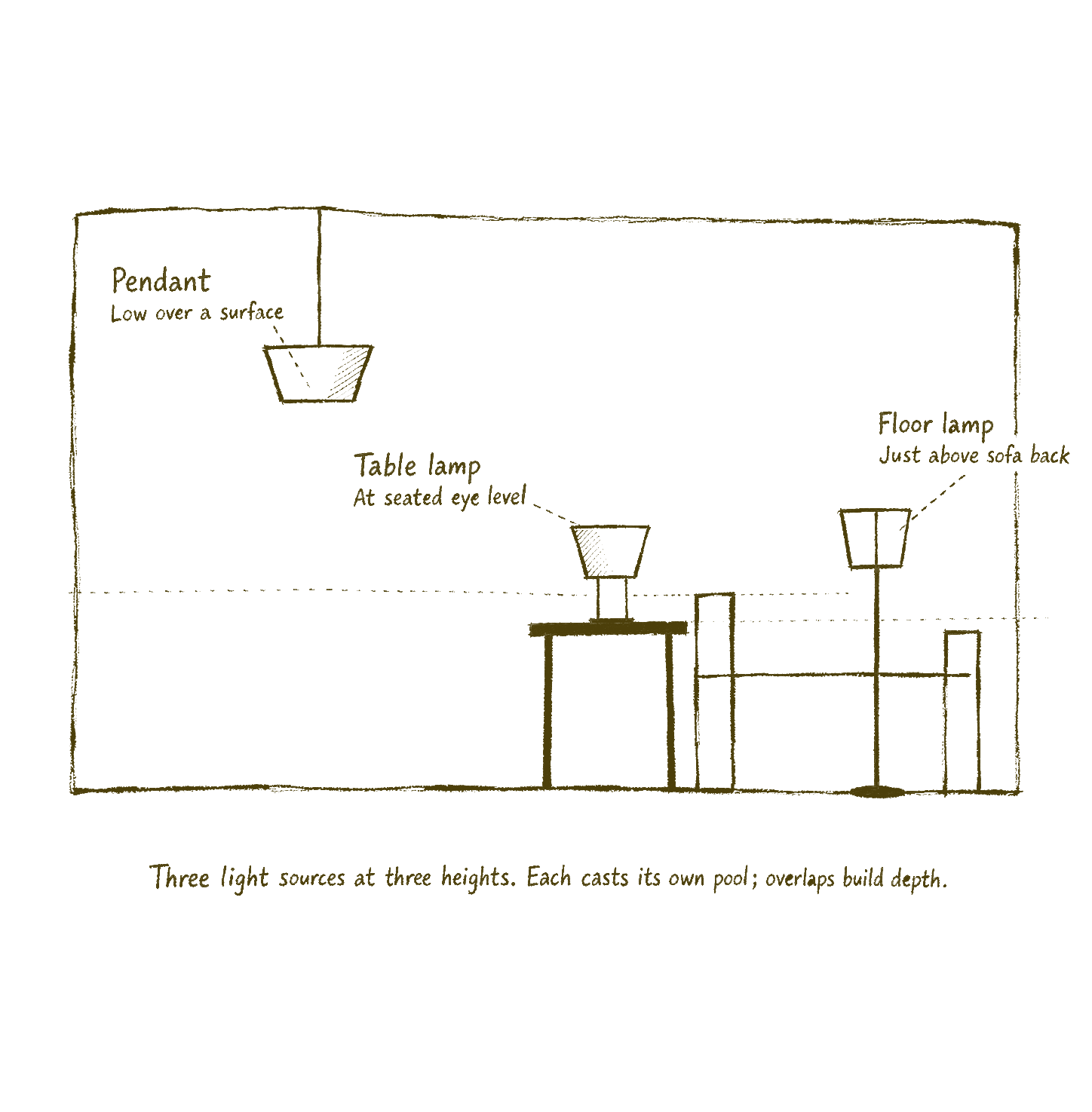
Most rooms have one light source. Most rooms need three. The unwritten rule of warm modernism is layered light at three heights: floor (a standing lamp or floor light, casting upward), table (lamps on side tables, casting at eye level), and ambient or overhead (a pendant, or for renters, a wall-mounted alternative). This is the single decision that separates a room that photographs well from a room that lives well. Overhead light alone flattens a space. Three light sources at varying heights builds depth. Lamps before any other accessory. They do more.
4. The coffee table
The coffee table is the second-most overthought object in a living room (after the sofa). The truth is that almost any well-proportioned table, in a material consistent with the rest of the room, works. The mistake is buying a table too large for the seating, or too tall.
The rule: the coffee table should sit one to two inches below the height of the sofa cushion, no higher. Its length should be roughly two-thirds the length of the sofa. Material — oak, travertine, rattan, ceramic — is a question of warmth. Glass and high-polish metal are colder than warm modernism allows.
5. The side table
A small piece, often skipped, that makes the room functional. Somewhere to put a lamp. Somewhere to put a cup. The side table is what turns a sofa from a piece of furniture into a place to sit. One per side of the sofa, ideally. They do not need to match.
6. One large piece on the wall
Not a gallery wall. One piece, scaled to the sofa beneath it — roughly two-thirds the width of the sofa, no smaller. A mirror, a single artwork, a textile, a hanging shelf. The point is to break the vertical emptiness and pull the eye up.

Of these, a floor-standing or wall-leaning mirror does the most for the least money. It adds light, depth, and architectural interest in one object.
7. The objects
Last, and only last, the smaller things. A vase. A bowl on the coffee table. A throw on the arm of the sofa. A book or two with covers worth seeing. The mistake is to buy these first. They are the punctuation of a room, not the sentence. A guideline: three to five well-chosen small objects do more than fifteen middling ones. The eye reads restraint as confidence.
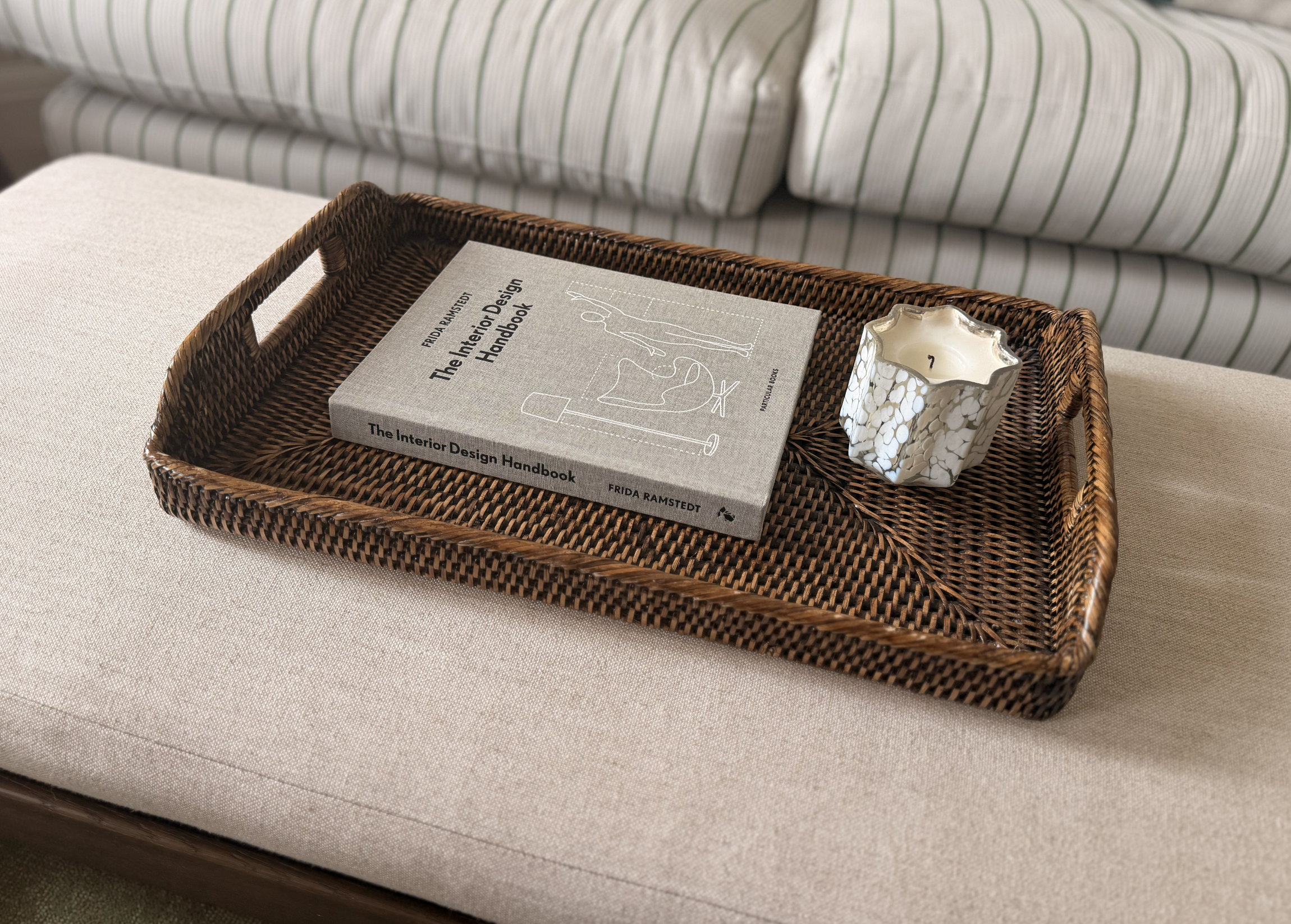
Rebecca Udall, Rattan Serving Tray: £65
A note on sequence over speed
A living room furnished in a weekend looks like a living room furnished in a weekend. A living room built over months, in the order above, looks considered — because it is. The order matters more than the budget. A £200 rug chosen before a £800 sofa will produce a better room than a £600 rug chosen after a £1,200 sofa. The decisions compound. Buy slowly. Buy in this order. The room will tell you when it is finished.