Six table lamps for modern rooms
A good table lamp does two jobs. It produces a useful pool of light at eye level — the second most important light source in any room, after the floor lamp — and it earns its place visually. The second job is the one most people forget. A room benefits from one or two objects that interrupt the quiet — pieces with enough presence to slow the eye when it passes. The table lamp is one of the easiest places to do this. It sits at eye level. It is small enough to be a gesture rather than a commitment. And the category is broad enough that there is a version of standout for almost any room.
1.The globe base
Some lamps do their work through restraint. Others do it through commitment. A patterned ceramic globe base topped with a bold shade belongs firmly in the second category. The form itself is classical: a round base, a wide tapered shade, the kind of proportions that have anchored rooms for a century. What changes the register is the surface: painted stripes or motifs on the base, a strong pattern woven into the linen shade.
What makes it a talking point is that it is unashamed. Most decorative lamps hedge — a muted pattern, a single tone of colour, the kind of softness that suggests the buyer was nervous. This kind of lamp does not. It commits to colour and to pattern, which is precisely what makes it work. A lamp like this anchors a room that has decided to have a personality. Look for: patterns that read as deliberate rather than printed, a shade in a pattern strong enough to talk to the base without competing with it.
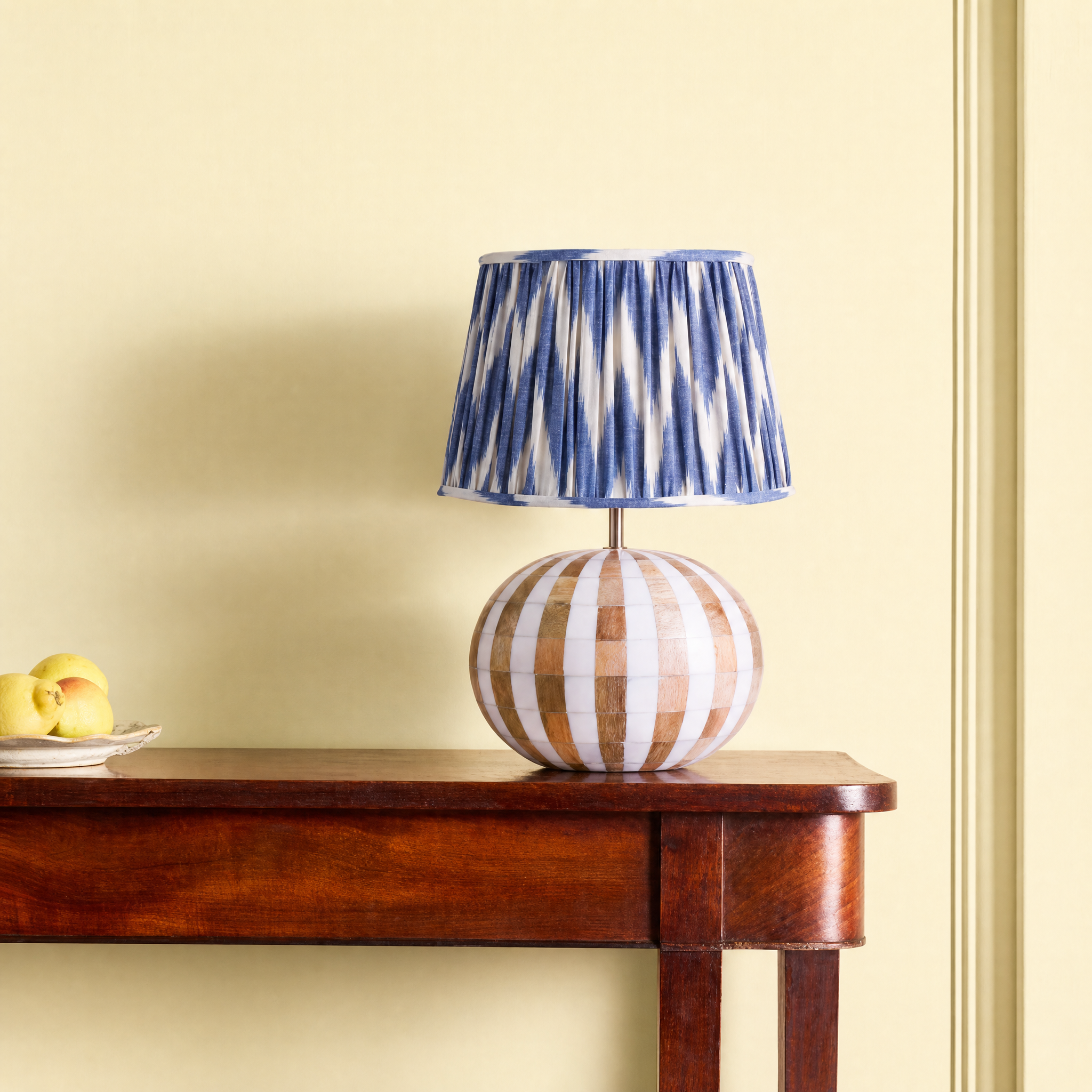
Pooky Lights, Cedella table lamp
2. Hand blown glass base
A lamp made entirely of coloured glass — the base, the body, sometimes the shade — has a quality no other material can replicate. Light does not just sit on the surface; it moves through it. A muted glass globe, lit from within, becomes its own light source twice over: once from the bulb, once from the colour of the glass itself catching and softening it.
The talking point is the weight. Hand-blown glass is heavy in a way that signals craft on contact. Pick it up and the heft alone tells you something was made carefully. In a room of pottery, wood, and linen, glass is the cool, translucent element that prevents the palette from becoming too uniformly warm. A single piece of considered glass changes the temperature of an entire room.
Look for: real hand-blown glass rather than moulded — visible irregularities in the surface, slight asymmetries, the small bubbles trapped inside the wall of the piece that machine-made glass does not have. The colour should be muted, drawn from nature: pale blue, sea-green, dusk grey, smoke. Bright primary tones read as decorative; muted tones read as material.
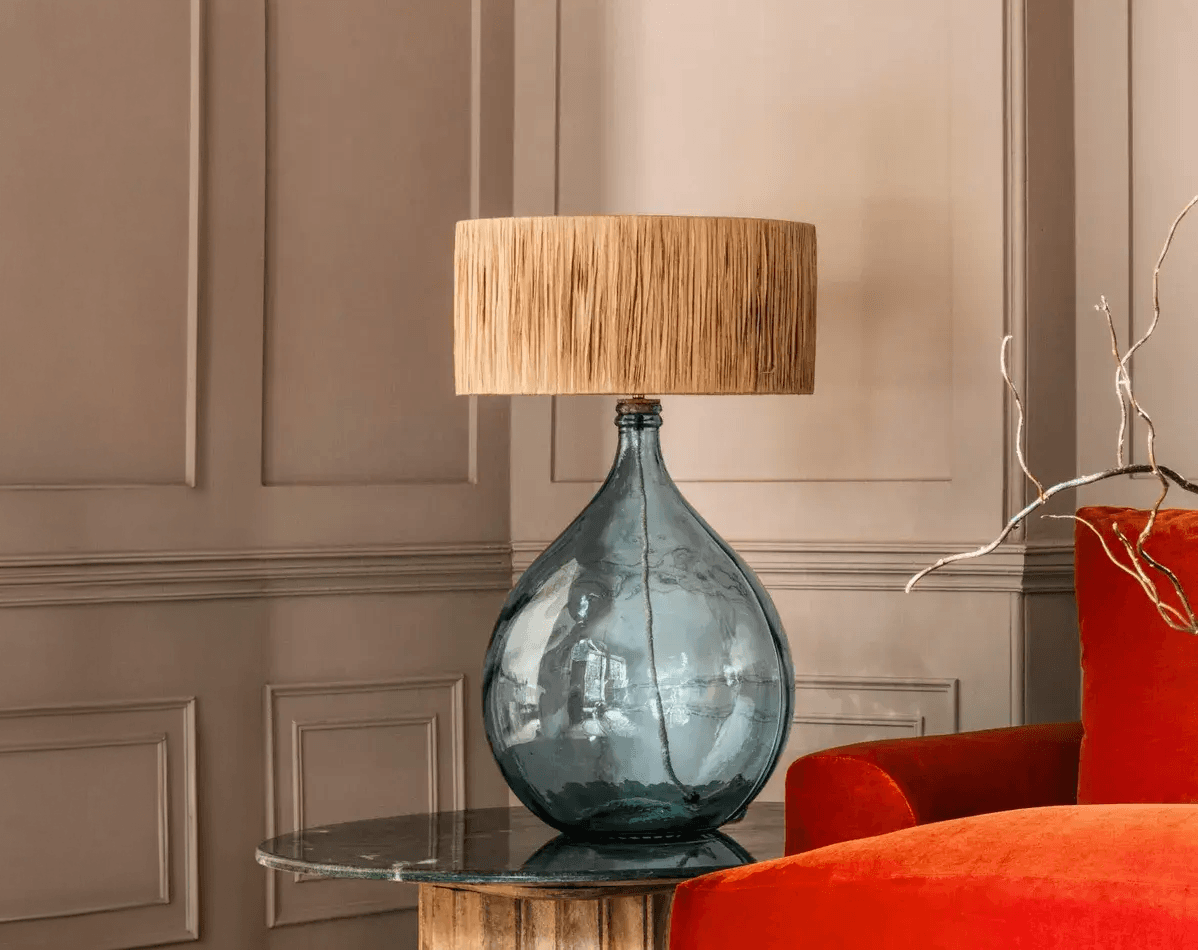
Graham & Green, extra large light blue handblown glass lamp
3. The handpainted ginger jar
The ginger jar is the most editorially loaded shape in the category. Its origins run back centuries to Chinese export porcelain, and its survival in considered English interiors — Rita Konig, Beata Heuman, Studio Ashby — is no accident. The form is one of the most resolved silhouettes ever produced: shoulders that hold weight visually, a narrow waist, a small lid that doubles as the lamp fitting. It has nothing left to add and nothing to remove.
What makes a particular ginger jar lamp a talking point is the painting. The strongest examples come from Jingdezhen — the Chinese city in Jiangxi province that has been producing porcelain for over 1,700 years — where ceramics are still made the way they have been for centuries: thrown, fired, painted, fired again. The work is uneven in the small ways that hand-work always is, and these inconsistencies are what distinguish a real piece from a printed reproduction. The result is a lamp that brings time into a room — not nostalgia, but craft history.
Look for: visible brushwork, slightly imperfect symmetry, a glaze that catches the light unevenly. Avoid printed transfer-decorated versions, which read flat from across the room even if convincing close up.
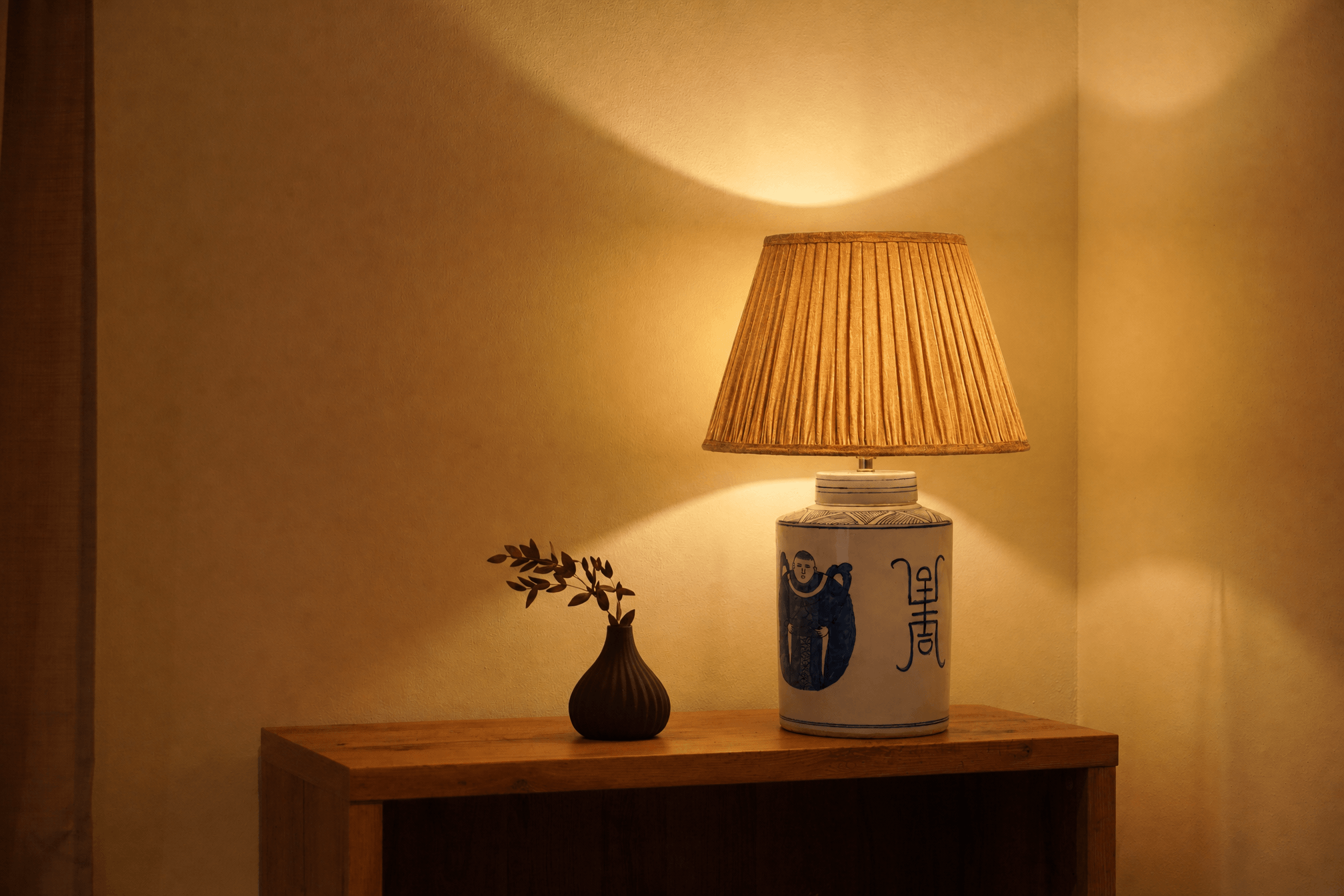
Oka, Wu Shou Table Lamp Base - Blue/White
4. The contemporary metal form
Most metal lamps default to one of two registers: industrial (warehouse, factory, exposed) or polished-traditional (brass, bedside, hotel). A third register exists in the middle — sculptural, contemporary, neither industrial nor traditional — and it is the most interesting place for a metal lamp to sit.
What makes this kind of lamp a talking point is the form, not the finish. A metal base with an unusual silhouette — asymmetrical, sculptural, slightly off — reads as an object first and a lamp second. It does the work of a small sculpture without the precious quality of one. The lamp is functional, yes, but the form is what justifies its place on the table.
Look for: brushed rather than highly polished metal, a silhouette that would still be interesting without the shade above it. The lamp should look like it was designed in the present rather than reproduced from a past period.
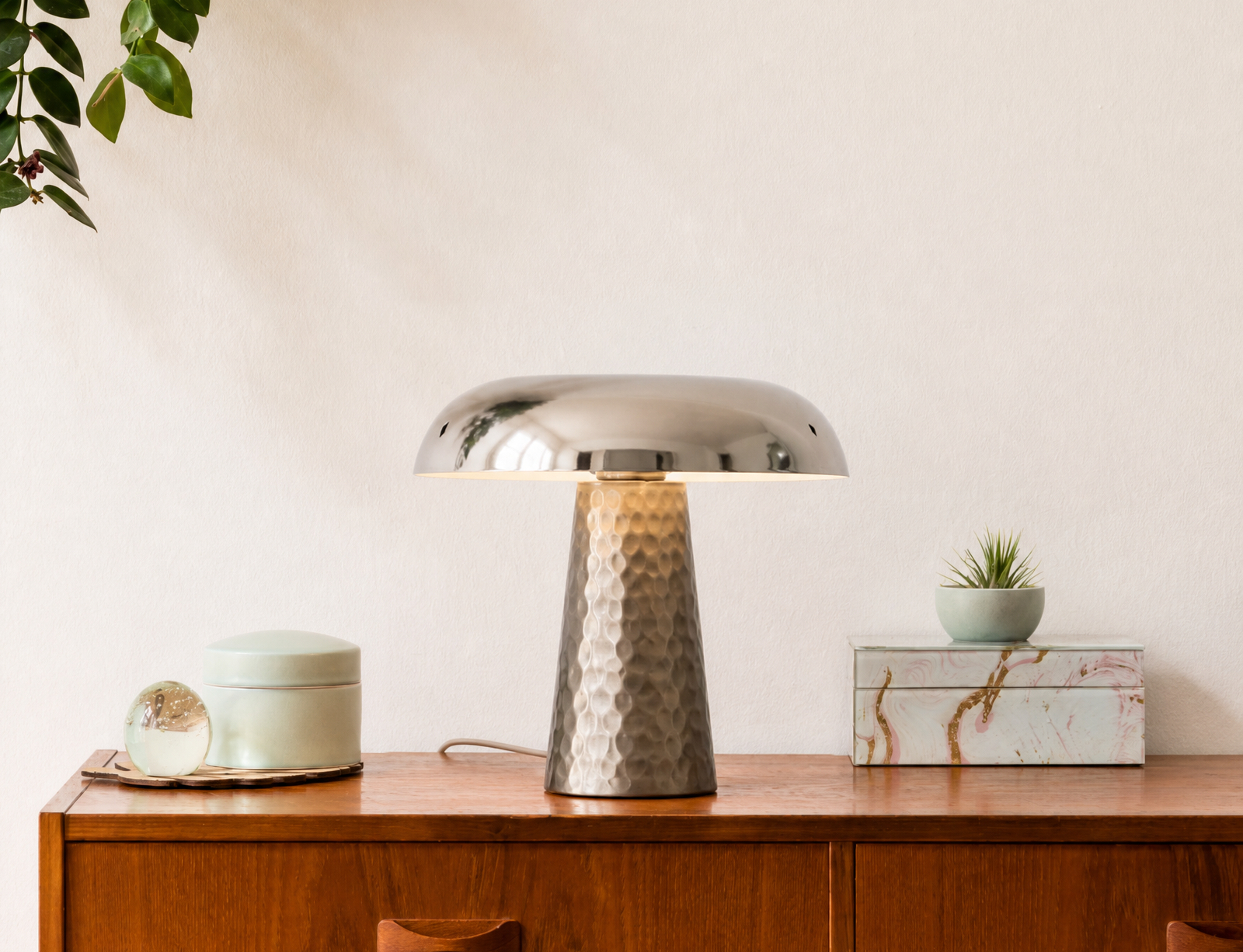
John Lewis, Deja Table Lamp, Silver
5. The paper shade on a wooden stem
A small reference to a much larger object. The paper lantern — usually pendant, usually overhead — translated downward to the table. The form reads as a small piece of architecture: a soft cylinder or sphere of paper, casting diffused light, sitting on a slim wooden stem.
What makes it a talking point is the scale of the gesture against the scale of the object. It looks like something that should be hanging from a ceiling. Placing it on a side table is the joke — and a good one, because the paper-on-stem table lamp brings the considered glow of Japanese lantern light into the smaller register of bedside or console. The lineage runs back to Noguchi's Akari series, and the form has barely needed to evolve since.
Look for: a paper shade with visible ribs, a wooden base that disappears beneath it rather than competing for attention. The cleanest versions are walnut or oak; metal or coloured bases tend to fight the soft register of the shade.
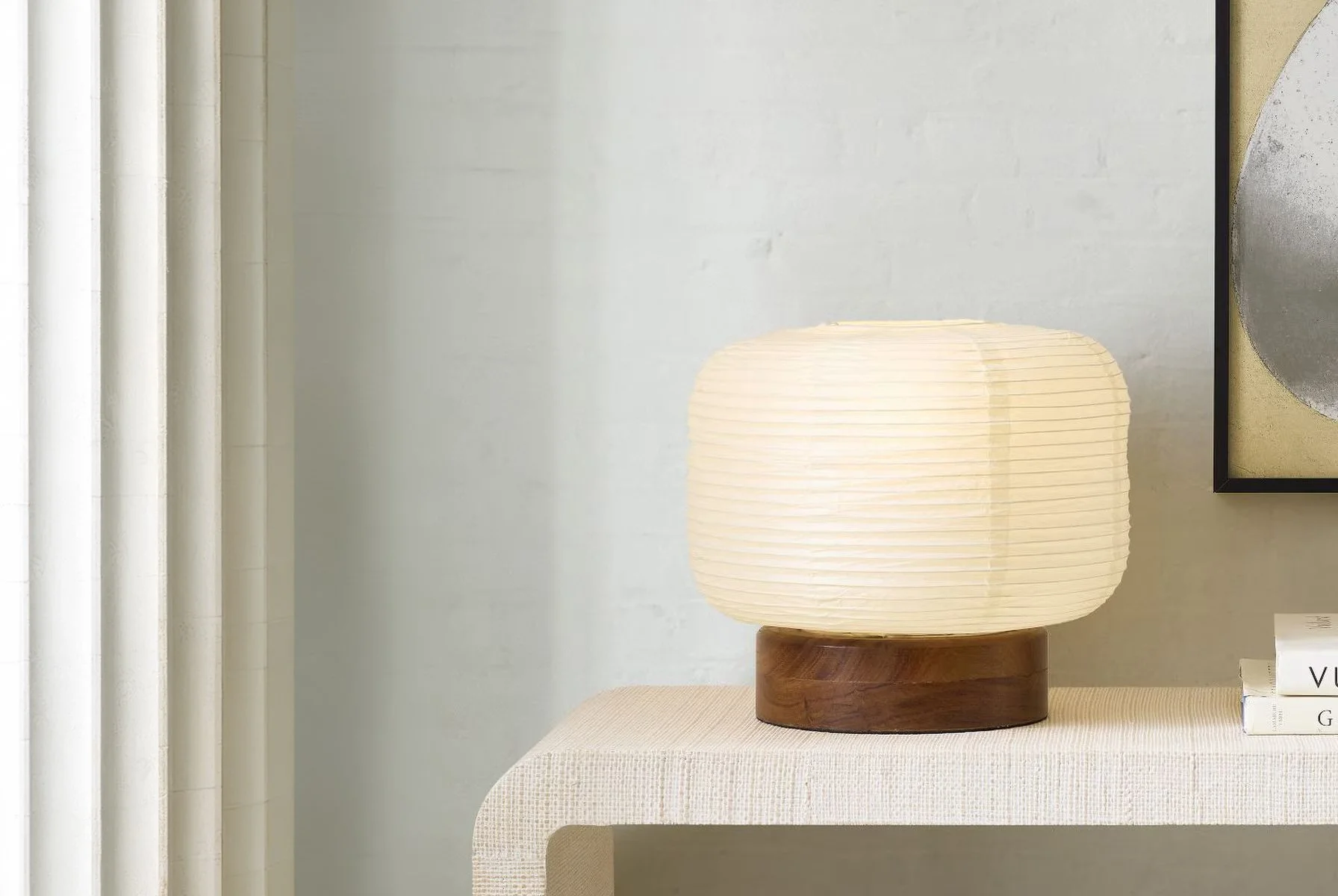
West Elm, Mooney Table Lamp
6. The vintage or vintage-style brass
The lamp that doesn't match. In a room of contemporary pieces, one object should be older than the rest — or look older. The right answer is rarely a generic vintage piece; it is something with a specific design lineage that the eye can read even before it knows the maker.
The mid-century Scandinavian makers — Kastrup-Holmegaard, Le Klint, Louis Poulsen, the Danish glassworks and lighting houses of the 1950s and 1960s — produced pieces that are still recognisable as correct to anyone with even a passing knowledge of the period, and quietly resolved to anyone without. A single piece of coloured hand-blown glass on a slim brass fitting, in muted olive or dusk blue, reads as instantly placed in time without needing to announce itself.
The talking point is the patina. A 1960s lamp is not pristine. The glass may have small bubbles, the brass may have softened to a darker tone, the original shade may have been replaced. These are not flaws to be apologised for; they are the reasons the piece reads as inherited. A vintage piece in a room of new ones signals that the room was built over time, not assembled in a season. Look for: a maker's label or paper sticker (often faded but present), hand-blown glass with visible irregularities, a brass fitting that has been allowed to age rather than re-lacquered to look new. Avoid pristine "vintage-style" reproductions; the point is that the piece is actually old.
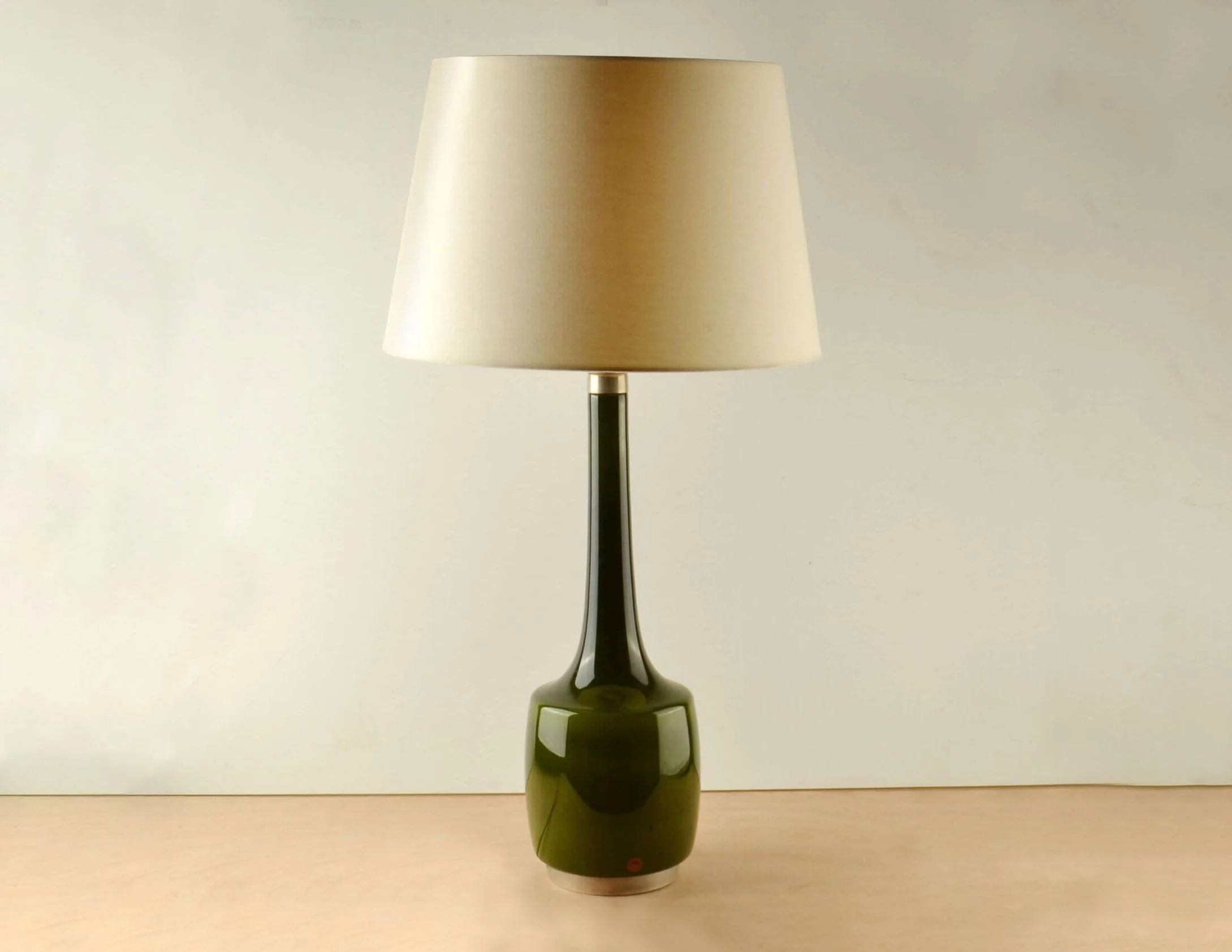
Vinterior, Tall Glass Olive Green Table Lamp By Kastrup, Denmark, 1960s